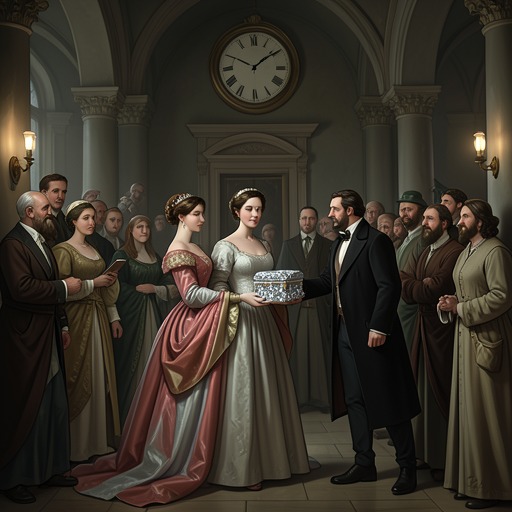
Madame Bonacieux
The Three MusketeersMadame Bonacieux is the queen’s seamstress, the wife of Monsieur Bonacieux, and a trusted link between the household of the queen and the dangerous world beyond the court. Her abduction turns an apparently private misfortune into a political crisis: because she is believed to possess knowledge of the queen’s secrets, her disappearance becomes part of the struggle among the queen, the cardinal, the king, and those seeking to involve the Duke of Buckingham in France.
Identity and Position
Madame Bonacieux has little dowry, but her marriage is made possible by the protection of Monsieur Laporte, the queen’s cloak bearer and her godfather. Her social position is therefore modest yet unusually valuable. She works as a seamstress to the queen and has been placed near the royal household by Monsieur Laporte so that the queen, watched by the cardinal and neglected by the king, may have at least one person in whom she can place confidence.
Her importance rests less on rank than on access and loyalty. She is not presented as a court grandee or political officeholder; instead, her ordinary occupation places her close to the queen’s person and allows private information to move through channels that formal authority cannot easily control. The contrast between her lowly material position and her proximity to royal secrets makes her vulnerable: the same trust that gives her significance also makes her a target.
Abduction and the Political Secret
Monsieur Bonacieux reports that his wife was abducted one morning as she left her workroom. He cannot identify the abductor with certainty, but he suspects that the seizure is connected with her devotion to the queen. He explains that Madame Bonacieux had recently confided that the queen was in great fear and that an attempt was being made to draw the Duke of Buckingham to Paris under the queen’s name, with the intention of bringing him into a snare.
The danger to Madame Bonacieux follows directly from what she knows. Her devotion to the queen is known, and those pursuing the queen’s secrets may wish either to separate her from her mistress, intimidate her, or seduce her into becoming a spy. The abduction is thus not random violence but an instrument of political surveillance. Information about the queen is treated as a weapon, and the seamstress becomes valuable precisely because her personal loyalty may preserve or reveal that information.
The account reaches d'Artagnan through Monsieur Bonacieux, who says that he learned it from his wife and, ultimately, from Monsieur Laporte. Yet even this chain of testimony remains incomplete. Monsieur Bonacieux has seen the suspected man once, when he was conveying his wife back to the Louvre, but he has no confirmed name, residence, or direct proof. Madame Bonacieux’s disappearance therefore appears first as a mystery whose fragments point toward the royal household without immediately disclosing the full machinery behind it.
The Mousetrap at the Bonacieux Residence
After the abduction, the apartment of Monsieur Bonacieux is converted into a mousetrap by the cardinal’s agents. A mousetrap is a concealed arrest procedure: suspected offenders are seized secretly, guards wait in ambush, and anyone entering the house is admitted, trapped, and interrogated. The apartment becomes less a home than a controlled information point, with every visitor treated as a possible connection to the missing woman or to the queen’s affairs.
The operation reveals the institutional scale of the threat surrounding Madame Bonacieux. The cardinal’s people do not merely search for her; they reconstruct her network by arresting those who might have visited the house. Their questions concern whether Madame Bonacieux sent anything to her husband or to another person, whether Monsieur Bonacieux sent anything to her, and whether either had communicated a secret. The investigators are seeking the hidden route by which messages might have passed, including information about whether the Duke of Buckingham is in Paris and whether he has met, or may meet, the queen.
D'Artagnan escapes the ordinary reach of the trap because he lodges on an upper floor with a separate passage. He turns his room into an observatory, watching visitors caught below. After removing a plank from the floor, he can hear the interrogations conducted in the room beneath him. Madame Bonacieux is physically absent, but her disappearance governs the entire arrangement: her home, her visitors, and the words spoken there are all absorbed into a system of monitoring and suspicion.
Connection with the Larger Conflict
Madame Bonacieux’s abduction is tied to the concealed relationship between the queen and the Duke of Buckingham, as well as to the political antagonism surrounding the queen’s position. The queen is watched by the cardinal, distrusted by the king, and described as betrayed by those around her. A trusted seamstress can therefore become a confidential intermediary in matters whose consequences extend beyond the household and into international conflict.
The later struggle at La Rochelle shows how private motives and public warfare become entangled in the same political world. The cardinal seeks to destroy La Rochelle, the last major bulwark of French Calvinism and the last port in France open to the English. The Duke of Buckingham arrives before the Isle of Ré with ninety vessels and nearly twenty thousand men, lands after a bloody conflict, and attempts to relieve the besieged city. The military contest is described as being driven not only by national and religious interests but also by Buckingham’s private desire to enter France as a conqueror and obtain a favorable sign from the queen.
The siege is ultimately shaped by material pressures: poor food leaves many English soldiers invalid, rough seas destroy vessels, and wreckage covers the shore. The English are then beaten back and forced to re-embark, leaving two thousand men, including senior officers, on the field. Within this wider conflict, Madame Bonacieux represents the fragile human channel through which political danger travels before it becomes open military action. Her knowledge belongs to a domestic sphere, but the forces trying to obtain it belong to the machinery of state and war.
Narrative Significance
Madame Bonacieux’s function in the narrative is to reveal how intimacy can become evidence and how ordinary spaces can be transformed by political fear. Her workroom, marriage, movements between the Louvre and her home, and relationship with Monsieur Laporte all acquire investigative importance. The story’s conspiratorial structure depends on such intermediaries: information does not move openly from ruler to ruler, but through servants, spouses, messengers, and trusted attendants whose vulnerability makes secrecy possible and precarious.
Her disappearance also initiates d'Artagnan’s involvement in the queen’s peril. The investigation of the abduction draws him into a network in which courage is useful only when joined to observation, concealment, and the ability to interpret incomplete testimony. Madame Bonacieux is therefore not merely a victim whose absence motivates another character. She is the point at which royal anxiety, marital suspicion, police surveillance, and international rivalry converge.
The contrast between her position and that of Milady is especially revealing. Madame Bonacieux’s value derives from devotion and service, while Milady’s power derives from disguise, manipulation, and the exploitation of secrets. Yet both women are treated by political systems as dangerous bearers of information and as objects to be controlled. The story places Madame Bonacieux’s vulnerable loyalty within the same culture of surveillance that later imprisons Milady, showing that the court’s secret politics can turn a woman’s trust, work, and movements into grounds for pursuit.